
Reviewer Guidelines
Peer review is central to the quality and credibility of the Journal of Interdisciplinary Perspectives (JIP). Reviewers help the editors decide whether a manuscript is suitable for publication, and they help authors improve their work. JIP relies on scholars and practitioners who give their time and expertise to evaluate manuscripts fairly, rigorously, and constructively.
JIP uses a double-blind peer-review process: reviewers do not know the identities of the authors, and authors do not know the identities of the reviewers. Each manuscript is evaluated by at least two reviewers with expertise relevant to the submission.
Review Screening
All peer reviews go through an editorial screening process. Only reviews that meet the journal's standards for rigor and constructiveness are formally accepted. A review may be returned to the reviewer for revision, or an additional reviewer may be invited, if it:
- lacks specific, actionable comments;
- does not address the criteria in the Peer Review Matrix; or
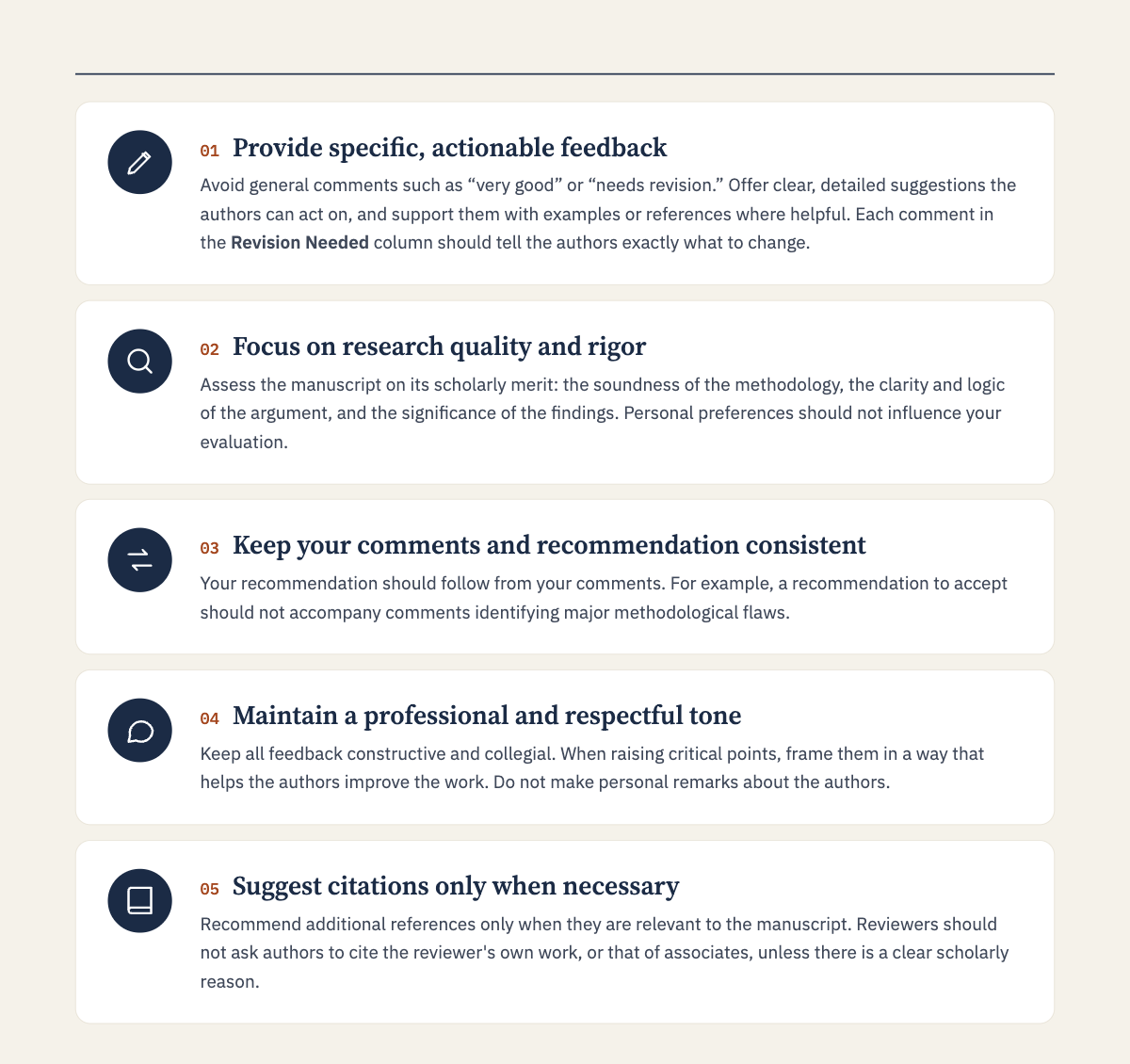
- gives a recommendation that is inconsistent with its comments.
Before Accepting an Invitation
Before agreeing to review a manuscript, please consider the following.
Expertise. Accept only if you have sufficient knowledge of the subject and methods to evaluate the manuscript competently. If only part of the manuscript falls within your expertise, tell the editor which parts you can assess.
Conflicts of interest. Decline, or consult the editor, if you have any competing interest that could affect your objectivity. Examples include a close personal or professional relationship with the authors; recent or current collaboration with them; working at the same institution; a financial interest in the research; or direct competition with the work. If you recognize the authors despite the blind review, inform the editor.
Availability. Reviews are due within 15 days of accepting the invitation. If you cannot meet the deadline, decline promptly or request an extension, so the authors are not kept waiting.
Confidentiality. Reviewers agree to keep confidential:
- all materials and information submitted to JIP for publication;
- all findings, determinations, outcomes, and comments associated with the reviews they perform; and
- all unpublished policies, procedures, and review mechanisms associated with the peer-review process.
The Peer Review Matrix
Reviewers evaluate manuscripts using the JIP Peer Review Matrix, which is available in the journal's online submission system. The matrix is provided to each reviewer with the review invitation, and every review must be submitted on it.
For each criterion, record your observations in two columns. Under Commendation, note the manuscript's strengths. Under Revision Needed, state the specific changes the authors should make.
Please leave the Actions Taken and Page Number columns blank. The authors complete these when responding to your review, so you and the editor can see how each comment was addressed.
If a criterion does not apply to the manuscript, such as Statistical Results in a qualitative study, write "Not applicable" rather than leaving it blank.
Evaluation Criteria
The matrix contains a detailed description for each criterion. In summary, reviewers should assess the following.
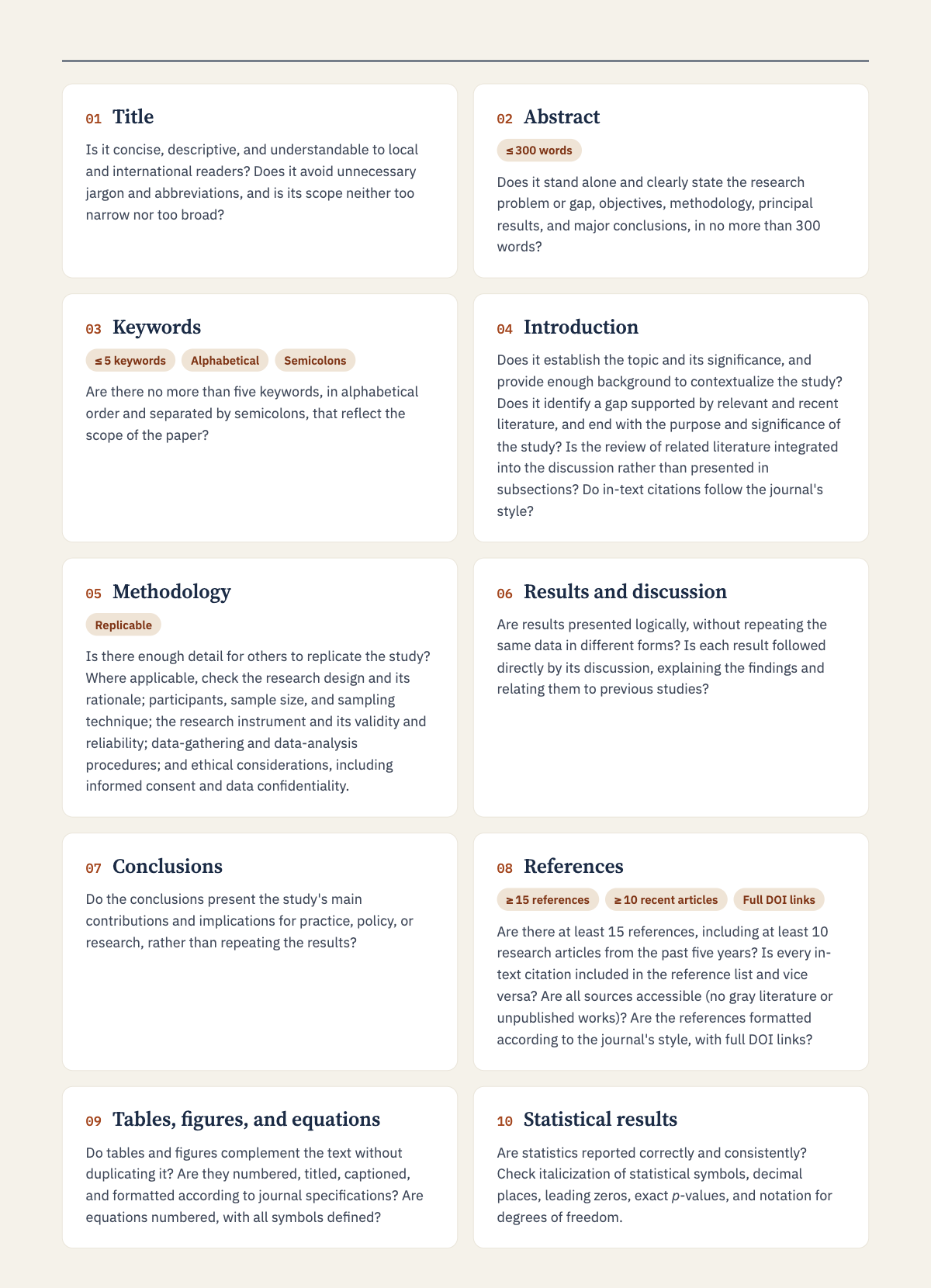
Making a Recommendation
At the end of the matrix, tick one recommendation.
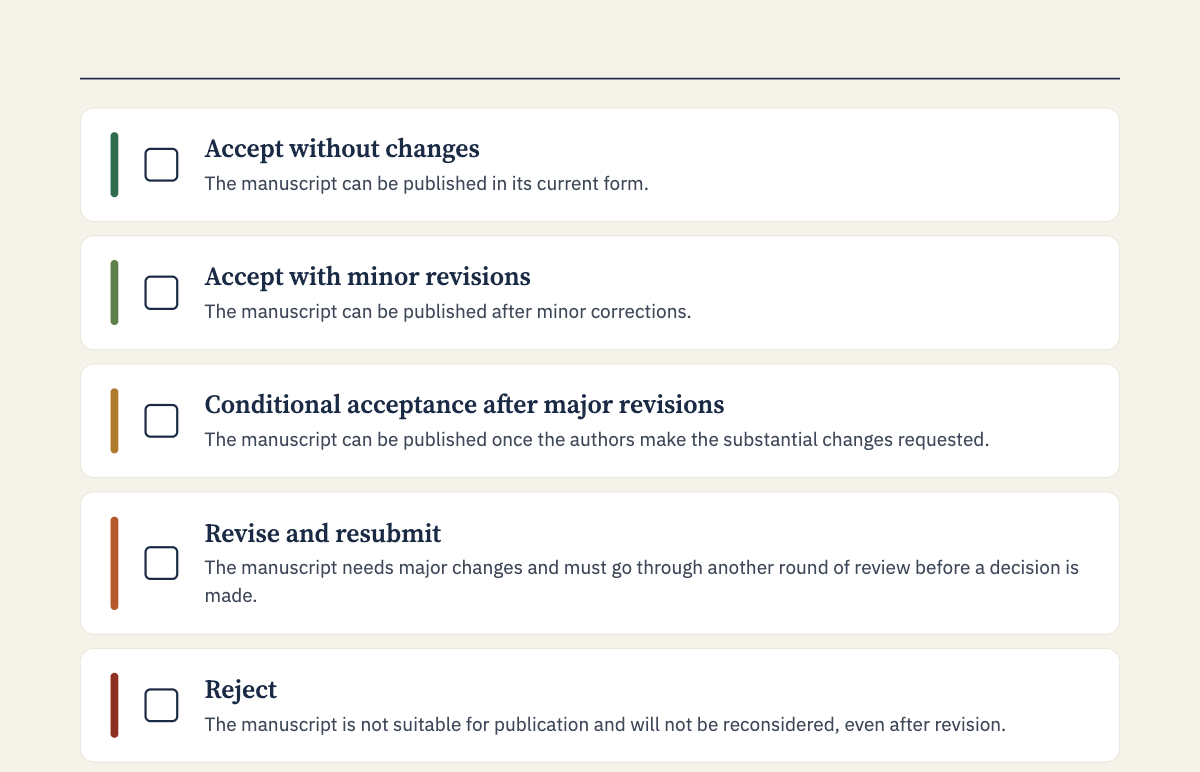
Your recommendation guides the editor, who makes the final decision, taking into account all reviews received. Please complete your details at the end of the form: name, department, institutional affiliation, designation, and email address.
Best Practices for Writing a Review
Ethical Concerns
If you suspect any of the following, do not investigate or contact the authors yourself. Instead, notify the editor confidentially and describe your concern in as much detail as possible.
- plagiarism, including substantial overlap with published work;
- fabrication or falsification of data;
- duplicate submission or redundant publication;
- unethical treatment of research participants, or missing ethical approval or informed consent where required.
Confidentiality and Use of AI Tools
Treat every manuscript and all information related to its review as confidential. Do not share, discuss, or use any part of a manuscript for your own purposes, and do not contact the authors directly.
Do not upload any part of a manuscript to generative AI tools or other external services that may store or reuse its content. The evaluation and the recommendation must be your own.
When your review is complete, permanently delete all electronic copies of the manuscript and related documents, and destroy any printed copies.