Vol. 4 No. 3 (2026): March 2026 Issue

					View Vol. 4 No. 3 (2026): March 2026 Issue

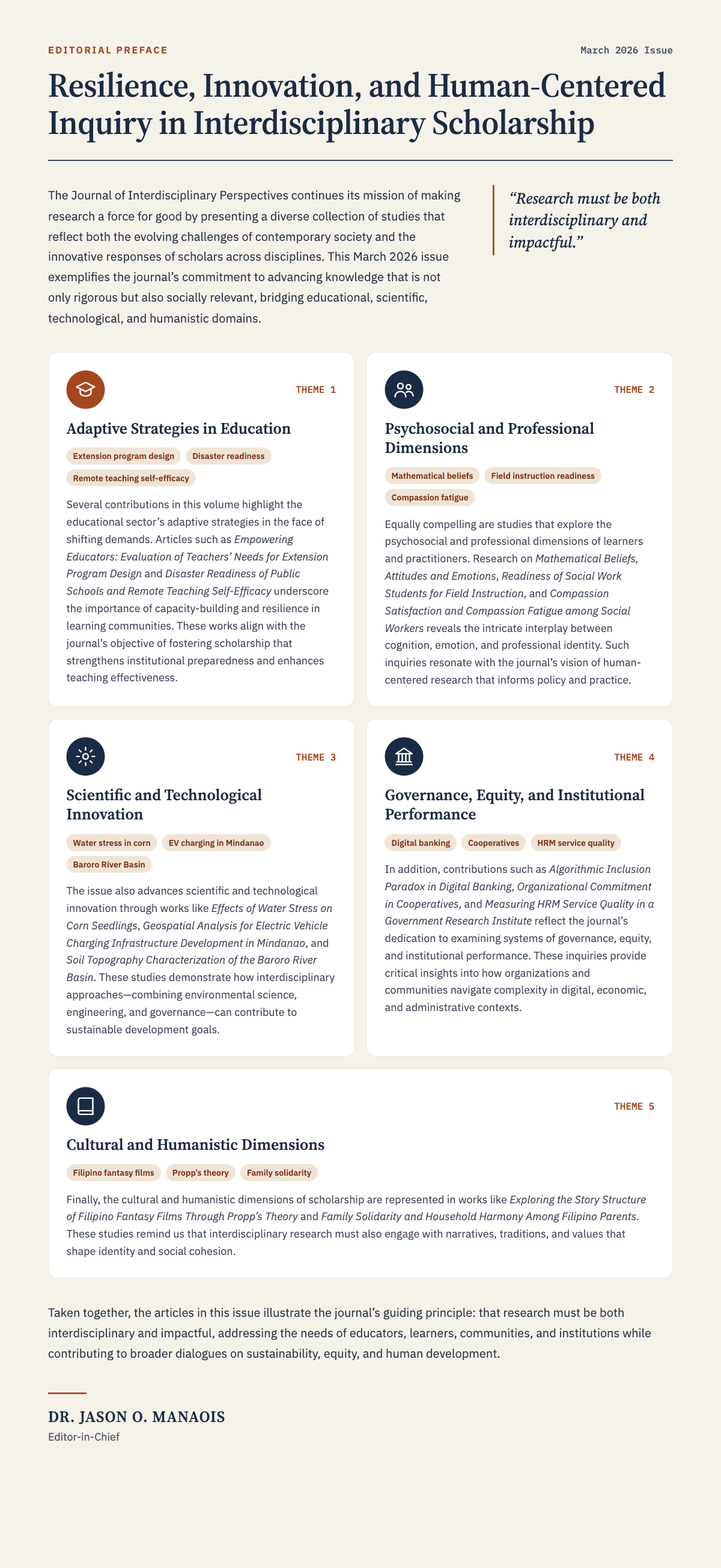
EDITORIAL PREFACE

Resilience, Innovation, and Human-Centered Inquiry in Interdisciplinary Scholarship

The Journal of Interdisciplinary Perspectives continues its mission of making research a force for good by presenting a diverse collection of studies that reflect both the evolving challenges of contemporary society and the innovative responses of scholars across disciplines. This March 2026 issue exemplifies the journal’s commitment to advancing knowledge that is not only rigorous but also socially relevant, bridging educational, scientific, technological, and humanistic domains.

Several contributions in this volume highlight the educational sector’s adaptive strategies in the face of shifting demands. Articles such as Empowering Educators: Evaluation of Teachers’ Needs for Extension Program Design and Disaster Readiness of Public Schools and Remote Teaching Self-Efficacy underscore the importance of capacity-building and resilience in learning communities. These works align with the journal’s objective of fostering scholarship that strengthens institutional preparedness and enhances teaching effectiveness.

Equally compelling are studies that explore the psychosocial and professional dimensions of learners and practitioners. Research on Mathematical Beliefs, Attitudes and Emotions, Readiness of Social Work Students for Field Instruction, and Compassion Satisfaction and Compassion Fatigue among Social Workers reveal the intricate interplay between cognition, emotion, and professional identity. Such inquiries resonate with the journal’s vision of human-centered research that informs policy and practice.

The issue also advances scientific and technological innovation through works like Effects of Water Stress on Corn Seedlings, Geospatial Analysis for Electric Vehicle Charging Infrastructure Development in Mindanao, and Soil Topography Characterization of the Baroro River Basin. These studies demonstrate how interdisciplinary approaches—combining environmental science, engineering, and governance—can contribute to sustainable development goals.

In addition, contributions such as Algorithmic Inclusion Paradox in Digital Banking, Organizational Commitment in Cooperatives, and Measuring HRM Service Quality in a Government Research Institute reflect the journal’s dedication to examining systems of governance, equity, and institutional performance. These inquiries provide critical insights into how organizations and communities navigate complexity in digital, economic, and administrative contexts.

Finally, the cultural and humanistic dimensions of scholarship are represented in works like Exploring the Story Structure of Filipino Fantasy Films Through Propp’s Theory, and Family Solidarity and Household Harmony Among Filipino Parents. These studies remind us that interdisciplinary research must also engage with narratives, traditions, and values that shape identity and social cohesion.

Taken together, the articles in this issue illustrate the journal’s guiding principle: that research must be both interdisciplinary and impactful, addressing the needs of educators, learners, communities, and institutions while contributing to broader dialogues on sustainability, equity, and human development.


DR. JASON O. MANAOIS
Editor-in-Chief

Published: 2026-02-04

Articles